01
Discovery
Two to three weeks with your operators, not just your executives. We map the workflow as it actually happens, including the spreadsheet everyone pretends doesn't exist.
Tip: press Ctrl + K from anywhere.
Most enterprise projects don't fail at launch. They fail eighteen months later, when the team that built them is gone. Climentos builds the system and staffs the people who keep it standing.
Trusted by teams who can't afford downtime
Climentos Technologies started in 2014 with four engineers in Bengaluru and one stubborn idea: the reason enterprise software rots is that the people who understand it leave. So we built two halves of one company — a delivery practice that ships, and a talent practice that staffs.
You can hire us for one, or for the whole chain. Most clients start with one and end up with the chain, which is either a compliment or a warning depending on your budget.
All servicesRetrieval systems, forecasting models and agent workflows that go to production — with evaluation harnesses, not vibes.
Explore BuildLine-of-business platforms where the domain is messy, the rules keep changing and off-the-shelf gave up.
Explore BuildFast, accessible, measurable front-ends. Core Web Vitals in the green on real devices, not just on your laptop.
Explore BuildNative and React Native apps built for patchy networks, old handsets and users who won't read a tooltip.
Explore BuildSpring Boot services, batch estates and the slow, careful modernisation of code older than some of our engineers.
Explore RunMigrations that finish, landing zones that pass audit, and a bill you can actually explain to finance.
Explore RunPipelines, IaC and observability. If a deploy still needs a person on a call at 11pm, we haven't finished.
Explore RunAutomation, performance and security testing wired into the pipeline — plus humans who try to break things creatively.
Explore BuildResearch, design systems and interfaces for people doing real work under time pressure.
Explore SystemsCustom pipelines and integrations for sales motions that don't fit anyone's default object model.
Explore SystemsFinance, inventory and manufacturing modules built or extended — with the migration plan written first.
Explore SystemsPayroll, attendance and performance tooling that survives an audit and an appraisal cycle in the same month.
Explore PeopleTechnical hiring run by people who can read the code. Average time-to-offer: 19 days.
Explore PeopleEmployment, education, criminal and address checks with a documented chain of custody and consent trail.
Explore PeopleDemand generation for technical products, measured on pipeline rather than impressions.
Explore PeopleCohort programmes in cloud, Java, AI engineering and secure coding — taught by people still shipping.
ExploreA demo takes a fortnight. A system your compliance officer will sign off takes longer, and it's the only kind worth paying for. Every Climentos AI engagement includes a golden dataset, a regression suite and a per-request cost budget before a single prompt reaches production.
Grounded answers over your own documents, with citations and access control inherited from your existing permissions.
Demand, risk and churn models with drift monitoring and a documented retraining cadence.
Multi-step automation with human checkpoints on anything that spends money or touches a customer.
Extraction from invoices, claims, contracts and scans — accuracy measured against a labelled set you keep.
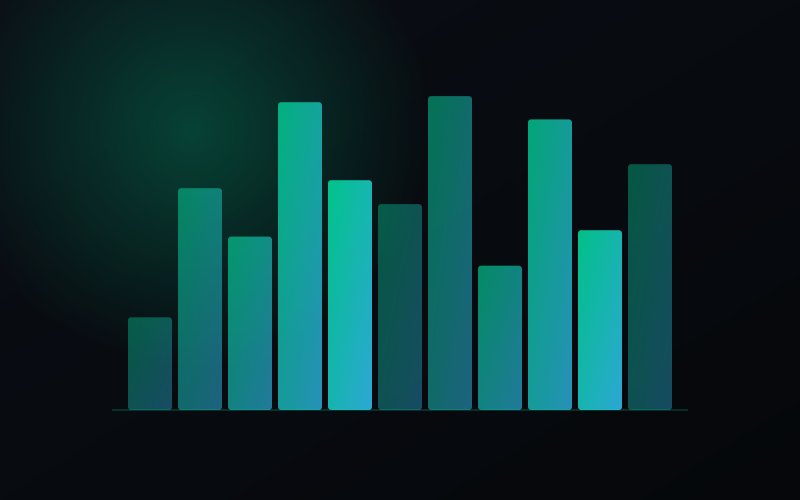
EVAL SCORE BY RELEASE · LAST 10
Five to twelve people — product, engineering, QA, design — working your ceremonies in your tools. Monthly rate, 30-day notice, no minimum term after month three.
Two to three weeks of paid discovery produces a specification, an architecture and a fixed price. If we're wrong about scope, that's our problem, not yours.
Vetted engineers embedded in your existing teams, with a Climentos tech lead reviewing quality on our side so you don't have to manage the vendor relationship.
Repositories, infrastructure, credentials, documentation and the runbook are yours from day one — not handed over at the end as leverage. We've never held a client hostage to a knowledge gap, and we're not about to start.
These are the tools we reach for most often. If your estate runs on something else, we'll learn it — we've inherited stranger things.
Domain knowledge is the difference between six weeks of requirements gathering and six days. These are the sectors where we've already made the expensive mistakes.
Core ledgers, payments, KYC and regulatory reporting.
Patient platforms, diagnostics workflows, HIPAA-grade data handling.
Omnichannel inventory, pricing engines, storefronts at scale.
Route optimisation, fleet telemetry, warehouse orchestration.
MES integration, predictive maintenance, shop-floor visibility.
Grid analytics, metering platforms, asset performance.
Learning platforms, assessment engines, institution systems.
Citizen services, records digitisation, accessibility compliance.
This is a real sequence, so it's numbered. Each stage has an exit artefact you keep whether or not you continue with us — the discovery document, the architecture, the runbook.
Two to three weeks with your operators, not just your executives. We map the workflow as it actually happens, including the spreadsheet everyone pretends doesn't exist.
A named principal engineer writes the design: data model, service boundaries, failure modes, and the three decisions you'll regret if we get them wrong.
Two-week sprints, working software at the end of each. Demos are open to anyone on your side who wants to watch, including the people who'll have to use it.
Load, security and failure testing against production-shaped data. We deliberately break it in staging so it doesn't surprise us on a Friday.
Phased cutover with a written rollback plan. We sit with your team through the first week, in your time zone, whatever that costs us in sleep.
Either we operate it under an SLA, or we train your team and step back. Both are real options; we'll tell you honestly which one your organisation is ready for.
The oldest system on this page went live in 2017 and has never had an unplanned outage longer than eleven minutes. That's the metric we're proudest of.
Full portfolio
Northbank ran reconciliation on a nightly batch that took four days to clear disputes. We replaced it with an event-sourced ledger, migrated 14 years of history, and cut settlement to under six hours.
Live re-routing across 2,400 vehicles, cutting empty-run kilometres by 22%.
One record across 38 clinics, with consent and audit built into the data layer.
Rules across 190 stores repricing in 40 seconds instead of overnight.

Fault prediction on 1.1M smart meters, 40 minutes of early warning on average.

Two false starts before we found the right migration order — we wrote both up for the client, and they're the reason the third attempt worked. Dual-running the old and new ledgers for eleven weeks cost more than anyone wanted, and it's the only reason zero transactions were lost.

Thirty-eight clinics, nine record systems and a merger deadline. The hard part wasn't the integration — it was persuading clinicians that a shared record wouldn't cost them time. So we rebuilt the intake screen first and let the results argue for us.
When a project ends, most firms leave and take the knowledge. Our recruitment practice hires and trains the team that takes over — often placing them with you permanently. That's why 96% of clients are still with us in year two.
Code, infra and docs live in your accounts. No escrow theatre.
Paid discovery first. 94% of fixed-scope projects land inside budget.
ISO 27001, SOC 2 Type II, GDPR and DPDP controls across every centre.
Delivery centres in Bengaluru, Pune, Dubai, London, Austin and Singapore mean at least four hours of live overlap with any client time zone — and a named engineer on call, not a ticket queue.
We ask every client for a reference six months after go-live, not on launch day. The enthusiasm is lower and the answers are more useful.
They told us our original plan wouldn't work and showed us the numbers. That conversation cost them three months of billing and bought them a client for six years.
The handover document was better than the one our own team writes. Two years on, we've extended the platform three times without calling them once — which I think is the point.
We needed eleven engineers in six weeks in a market where nobody had eleven engineers. They found nine, trained two internal transfers, and none of them have left.
Every centre runs the same review gates, the same security controls and the same definition of done. Where you're billed from changes the rate; it doesn't change the work.
No thought leadership, no predictions for next year. Just what we learned on a project recently, including the parts that were embarrassing.
All articles
What parallel-running a financial system actually costs, and why we'd do it again.

How we build golden datasets that catch regressions before customers do.

Three years of data from replacing whiteboard rounds with paid work samples.
If yours isn't here, the chat button on the right reaches a person during Indian business hours.
Ask us directlyThirty minutes with a principal engineer — no salespeople, no deck. You leave with an honest read on scope, cost and whether we're the right firm for it.
Or email hello@climentos.com · Replies within one business day
Two minutes from discovery to handover, narrated by a delivery lead.
Drop your own file at assets/videos/how-we-work.mp4 to replace this placeholder.
Tell us the shape of the problem. We'll come back with a build plan, a team shape and a number — no obligation, no deck.